
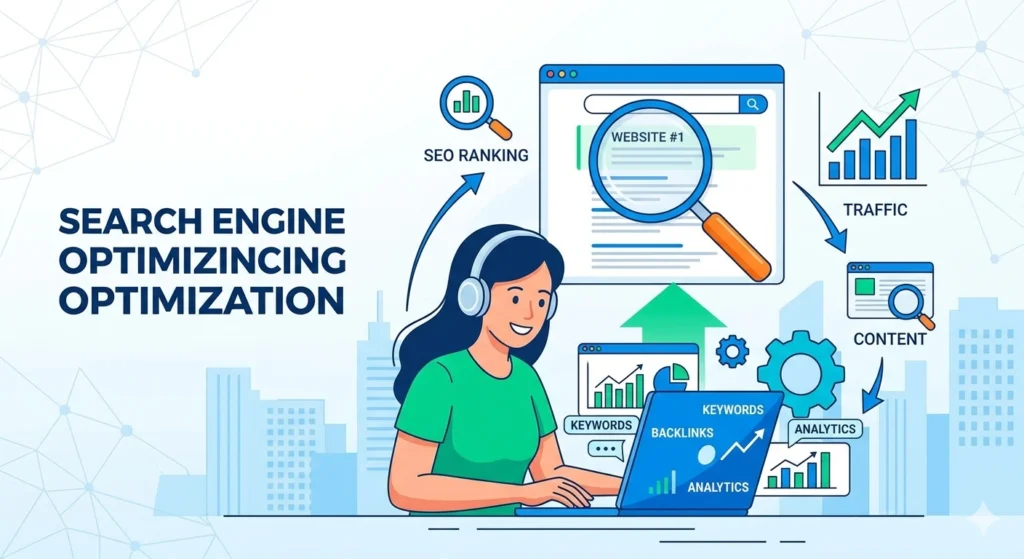
Search Engine Optimization (SEO) is the process of improving your website’s visibility on search engines when users search for products or services related to your business. The goal is to rank higher in search engine results pages (SERPs), which increases the chances of attracting potential customers.
It is involves optimizing various elements such as content, website structure, keywords, and backlinks to ensure your website meets search engine algorithms.
Why SEO is Important for Your Business
1. Increases Organic Traffic
SEO helps your website appear in front of users who are actively searching for your services. Natural traffic is free and long-lasting, in contrast to paid advertisements.
2. Builds Credibility and Trust
Websites that rank higher on Google are often seen as more trustworthy. SEO helps build authority through quality content and backlinks.
3. Cost-Effective Marketing
Compared to paid advertising, SEO provides long-term results with lower investment. Once your site ranks well, it continues to attract traffic without ongoing costs.
4. Better User Experience
It is not just about search engines—it also focuses on improving user experience by making your website faster, mobile-friendly, and easy to navigate
5. Higher Conversion Rates
SEO targets users who are already interested in your services, making them more likely to convert into customers.
Types of SEO
On-Page SEO
Optimizing components on your website is known as “on-page .
Key components:
Keyword optimization
Meta titles and descriptions
Header tags (H1, H2, H3)
Internal linking
Image optimization
Off-Page SEO
Off-page focuses on activities outside your website to improve rankings.
Key components:
Backlinks from other websites
Social media marketing
Guest blogging
Influencer outreach
Technical SEO
Technical ensures your website is structured properly for search engines to crawl and index.
Key components:
Website speed optimization
Mobile responsiveness
XML sitemaps
Secure HTTPS connection
Fixing broken links
How Search Engines Work
Search engines like Google use bots (also called crawlers) to scan websites and collect information.
The process involves three steps:
1. Crawling
Search engines discover new and updated pages using bots.
2. Indexing
Pages are stored in a database and analyzed based on content and relevance.
3. Ranking
Search engines rank pages based on various factors such as quality, relevance, and authority.
Keyword Research: The Foundation of SEO
One of the most crucial elements of Search engine is keyword research. It involves finding the words and phrases your target audience is searching for.
Tips for Keyword Research:
Use tools like Google Keyword Planner
Focus on long-tail keywords
Analyze competitor keywords
Choose keywords with high search volume and low competition
Example: Instead of targeting “digital marketing,” you can target “best digital marketing agency in Tamil Nadu.”
Content Optimization
Content is king in SEO. High-quality content helps attract and engage users while improving search rankings.
Best Practices:
Write valuable and informative content.
Use keywords naturally
Add headings and subheadings.
Include images and videos.
Update content regularly.
Google prioritizes content that provides real value to users, so focus on solving problems and answering questions.
Importance of Backlinks
Links to your website from other websites are known as backlinks. They act as a vote of confidence and signal to search engines that your content is valuable.
Ways to Build Backlinks:
Guest blogging
Creating shareable content
Directory submissions
Collaborations
Quality matters more than quantity. A few high-quality backlinks are better than many low-quality ones.
Technical SEO Essentials
Technical SEO ensures that your website performs well and is easy for search engines to understand.
Key Factors:
Fast loading speed
Mobile-friendly design
Clean URL structure
Secure website (HTTPS)
Proper use of schema markup
A technically strong website improves both user experience and search rankings.
Local SEO: Targeting Nearby Customers
If you run a local business, local SEO is essential.
Key Strategies:
Optimize Google Business Profile
Use location-based keywords.
Collect customer reviews.
Add your business to local directories.
It helps your business appear in “near me” searches and Google Maps results.
Common SEO Mistakes to Avoid
Even small mistakes can hurt your website performance.
Avoid these:
Keyword stuffing
Duplicate content
Ignoring mobile optimization
Slow website speed
Poor-quality backlinks
Focus on quality and user experience rather than trying to trick search engines.
SEO Trends to Watch
It is constantly evolving. Staying updated with trends is important for long-term success.
Key Trends:
Voice search optimization
AI-driven search algorithms
Mobile-first indexing
Video optimization
Core Web Vitals
Adapting to these trends helps maintain your competitive edge.
How Long Does SEO Take?
It is a long-term strategy. Results typically take 3 to 6 months, depending on competition and effort. However, the results are sustainable and continue to grow over time.
Why Choose a Professional SEO Agency?
While SEO can be done independently, working with a professional agency provides better results.
Benefits:
Expertise and experience
Advanced tools and analytics
Time-saving
Customized strategies
Continuous optimization
A good agency focuses on data-driven strategies and measurable results.
Follow us on Instagram.
For more service click here